

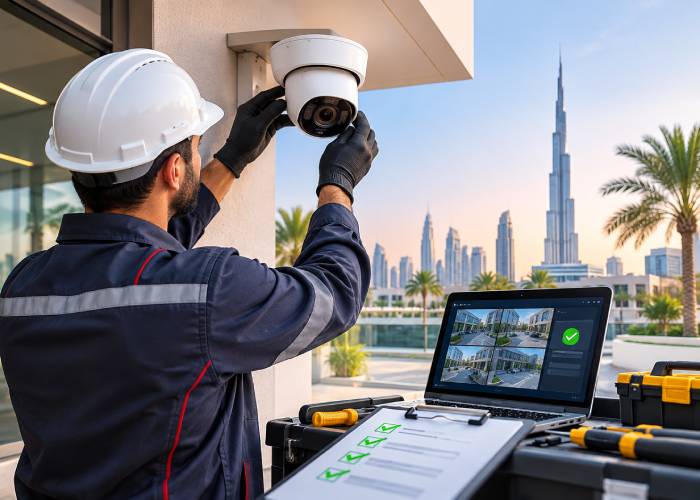
Most businesses only look closely at their CCTV after something goes wrong. A customer reports a stolen phone, stock goes missing from the warehouse, or Dubai Police ask for footage from a specific afternoon. Then someone opens the recorder and finds that camera 6 has been dark for weeks, or that the hard drive only holds four days of video.
Regular CCTV maintenance in Dubai is meant to stop that from happening. For many buildings, it’s also a legal requirement. If your premises fall under SIRA (Dubai’s Security Industry Regulatory Agency), you must have a maintenance contract with a SIRA-registered company and at least four preventive visits every year.
This guide explains what SIRA actually asks for, what a good CCTV AMC Dubai contract should cover, how often different businesses should get their cameras checked, and what affects the cost. The rules here come from SIRA’s Preventive Systems Manual, approved under Administrative Resolution No. (13) of 2025, and from Dubai Law No. (12) of 2016.
At a glance: SIRA CCTV maintenance rules ● Maintenance contract: an annual contract with a SIRA-registered company is required ● Preventive visits: at least 4 a year ● Who does the work: SIRA-licensed technicians only ● Recording retention: at least 31 days (75 days for bank ATM cameras) ● Storage headroom: recorders sized with 20% extra capacity ● Backup power: every recorder on a UPS, for at least 30 minutes ● System down? Report it to SIRA and your maintenance company straight away |
Why CCTV systems fail quietly (and when you find out too late)
CCTV rarely breaks all at once. It wears down one part at a time, and the system often looks normal the whole while.
Live view and recorded footage are two different things
The monitor at the security desk shows live video. That proves the camera works. It doesn’t prove the recorder is saving the video. A failing hard drive can lose hours of footage every night while the live screens look perfect.
That’s why a proper CCTV inspection in Dubai includes playing back old footage on every channel, as well as checking the live screens.
Dubai’s climate wears equipment out faster
Outdoor cameras here sit through summer heat that regularly goes past 45°C, along with dust, sand and coastal humidity. Dust builds up on lenses and inside recorder vents. Heat shortens the life of hard drives, power supplies and the infrared lights cameras use at night.
You won’t see one dramatic failure. You’ll see blurry images, recorders that run hot and cameras that go black after sunset. Scheduled SIRA CCTV maintenance visits are there to catch these slow problems before you need the footage.
SIRA requirements in plain language: maintenance, recording retention, approved companies
Who has to follow the rules
Dubai Law No. (12) of 2016 names three groups that must have security systems built to SIRA standards. The first is “vital sectors”: banks, money exchanges, jewellery shops, hotels, shopping malls and hospitals. The second is “major compounds”: residential or office buildings, towers and villa compounds. The third is public events open to the general public.
SIRA’s manual then sets out the detailed requirements for each type of facility. If you’re not sure whether your premises is covered, your SIRA-approved installer or SIRA itself can confirm it.
The maintenance rules
Part Two, Chapter 7 of the manual is clear. The facility must sign an annual maintenance contract with a SIRA-registered company. The contract must include a preventive maintenance programme of no fewer than four visits a year, plus terms for responding to faults and penalties if the company doesn’t deliver. Every member of the technical crew must hold a SIRA licence.
Two more rules catch people out. If the maintenance company isn’t sticking to the contract, the facility has to tell SIRA. And any change to the system must be documented and reported to SIRA, however small. That includes moving cameras, changing the layout, new lighting and anything new that blocks a camera’s view. This matters a lot if you’re moving or refitting offices, which is why CCTV is part of our office IT relocation checklist.
So when you compare the CCTV annual maintenance contract UAE providers offer you, check that the four visits, a fault response plan and licensed staff are all written into the contract.
Recording retention and storage
People who look up NVR storage retention SIRA rules usually want one number. For most facilities, it’s 31 days.
The manual says motion-based recording must cover at least 70% of the day for each camera, at no less than 10 frames per second, and be kept for at least 31 days. Banks have a stricter rule for ATM cameras, which must be kept for at least 75 days. Jewellery exhibitions must keep their recordings for one month after the event ends.
The recorder itself must be sized with 20% extra capacity and must accept extra storage devices. It must also send an alarm if a disc fails. If overwriting is switched off, it must alert you when the disc is full.
Time, power and incidents
SIRA requires every part of the system to keep the correct time and date, synced automatically. Recorders must support NTP (Network Time Protocol) to do this.
Every recorder must be connected to a UPS that keeps the system running for at least 30 minutes during a power cut. Our guide to UPS sizing, runtime and maintenance explains how to size one properly.
If an incident stops your security systems from working, you must report it to SIRA and your maintenance company immediately. Every time footage is copied, it must also be logged on SIRA’s approved form, recording who made the copy and where it went.
What happens if you don’t comply
Article 21 of Law No. (12) of 2016, as replaced by Law No. (3) of 2018, allows fines of up to AED 500,000. Repeat the same violation within a year and the fine doubles, up to AED 1,000,000. The fine for each specific violation is set by a separate Executive Council resolution.
What a CCTV AMC should include: preventive visits, cleaning, firmware, storage checks
SIRA sets the minimum. A good CCTV AMC Dubai contract goes further and spells out what happens on each visit, so you can check the work was actually done.
What a preventive visit should cover
- Play back recordings from several days and weeks ago on every channel
- Confirm storage holds at least 31 days, with SIRA’s 20% headroom
- Check hard drive health and replace drives that show errors before they fail
- Confirm the recorder clock matches network time
- Test night vision on every camera
- Check each camera angle against the approved layout
- Test UPS battery health and runtime
- Inspect cables, connectors and outdoor housings for sun and water damage
Cleaning
Lenses and camera housings need cleaning on every visit. Recorder vents and fans need it too, because a dusty recorder runs hot and its drives fail sooner. Outdoor cameras need extra cleaning after sandstorms.
Firmware and passwords
Camera and recorder makers release firmware updates that fix bugs and security holes. Your AMC should cover checking and installing approved updates, and removing any default passwords.
Keep in mind that SIRA requires security systems to run on a dedicated network. Connecting to any outside network, including for remote viewing, needs SIRA’s written approval in advance and a firewall.
Reports and response times
You should get a written report after every visit that lists what was checked, what was fixed and what needs attention. The contract should also state how quickly a technician will come out for a breakdown and whether replacement parts are included. If you’re reviewing your wider IT setup at the same time, our year-end IT infrastructure audit checklist covers the rest.
Recommended maintenance frequency by business type
SIRA’s minimum is four visits a year for every covered facility. Treat that as the starting point. Sites with higher risk, or harsher conditions, need more attention.
The table below is our recommended schedule for CCTV maintenance in Dubai. It’s practical guidance, separate from the legal minimum.
| Facility / business type | SIRA minimum (where applicable) | Recommended maintenance schedule | Practical reason for extra checks |
|---|---|---|---|
| Offices and commercial towers | At least 4 visits annually. | Quarterly service plus monthly recording-health checks. | Confirm active channels, storage retention and reliable indoor coverage. |
| Residential buildings and villa compounds | At least 4 visits annually. | Quarterly service; inspect outdoor cameras before summer. | Check car parks, gates and weather-exposed perimeter cameras. |
| Retail shops and malls | At least 4 visits annually. | Quarterly service plus monthly system-health checks. | High footfall and frequent incident footage requests need dependable playback. |
| Hotels | At least 4 visits annually. | Quarterly service plus monthly system-health checks. | Many 24/7 cameras require regular recorder and storage checks. |
| Hospitals | At least 4 visits annually. | Service approximately every two months. | Continuous operations and numerous entrances increase monitoring needs. |
| Banks, exchanges and jewellery shops | At least 4 visits annually. | Monthly preventive inspection. | Higher security exposure; check ATM footage retention where applicable. |
| Warehouses and industrial sites | At least 4 visits annually. | Quarterly service plus additional summer lens cleaning. | Dust, loading areas and outdoor equipment accelerate image-quality issues. |
| Private villas outside a compound | Confirm SIRA applicability. | Good-practice inspection twice a year. | Check NVR drives, camera views and night vision despite lower site complexity. |
How to use this comparison: The visit frequencies above beyond four annual visits are Technocom editorial recommendations, not additional SIRA legal requirements. Confirm site classification, approved system design and any special retention rules with SIRA.
A monthly health check means a technician confirms every channel is recording and the drives are healthy. Where SIRA has approved remote access, this can be done online between site visits. It doesn’t replace a full CCTV inspection in Dubai, but it shortens the time a fault can go unnoticed.
Common faults: dead cameras, full drives, time drift, IR failure in heat
Dead or offline cameras
A camera usually goes offline because of a failed power supply or PoE port, water getting into a connector, a damaged cable or tampering. Most of these are quick to fix on a CCTV repair in Dubai call-out. If the fault stops your system from working, remember it has to be reported to SIRA.
Full or failing hard drives
Recorders write video around the clock, so their drives wear out faster than drives in an office PC. Sometimes the drive is healthy, but the settings are wrong, and the recorder stops recording once the disc fills up. Either way, the 31-day retention rule is broken without anyone noticing.
Time drift
Recorder clocks slowly drift if they aren’t synced. After a few months, the timestamp can be minutes off. That makes footage harder to use as evidence, because the time on screen doesn’t match what actually happened. Automatic NTP sync, which SIRA requires, fixes this.
IR failure in the heat
SIRA requires cameras to have infrared light and switch automatically to black and white at night. IR LEDs weaken over time, and constant heat speeds this up. Spider webs near the lens also reflect the IR light and blur the image. Regular SIRA CCTV maintenance includes testing night vision on every camera, because daytime footage won’t show this fault.
Cost factors for CCTV AMC in Dubai
There’s no fixed SIRA price for a CCTV AMC in Dubai. Every quote depends on the site.
What changes the price
The biggest factor is the number of cameras and recorders. After that comes the type of system (older analogue or IP), how many drives need monitoring, and how hard the cameras are to reach. A camera on a tower facade costs more to service than one in a corridor.
Your facility type matters too. A bank or jewellery shop needs more visits and faster response times than a small office. Adding intruder alarms, access control or UPS units to the same contract changes the price, but usually costs less than separate contracts.
Parts-included vs labour-only contracts
A parts-included contract covers replacement parts, labour and emergency call-outs for a fixed yearly fee. A labour-only contract covers scheduled visits and labour, and parts are quoted separately when needed. The first gives you a predictable budget. The second costs less upfront but can mean surprise bills for CCTV repair in Dubai when drives or cameras fail.
For reference, one Dubai provider’s 2026 pricing guide puts basic maintenance packages, mostly for small home setups, at AED 500 to AED 2,000 a year. A SIRA-compliant CCTV annual maintenance contract UAE businesses sign for commercial sites is normally quoted after a site survey.
How Technocom maintains CCTV under AMC
Technocom handles CCTV installation and SIRA certification, then keeps systems compliant through annual maintenance contracts run by SIRA-certified maintenance engineers.
There are two options. The parts-included plan covers parts, labour and emergency call-outs, and suits banks, data centres, government and high-value commercial sites. The labour-and-scheduled-maintenance plan suits offices, retail and hospitality, with parts quoted when needed.
Visit dates are agreed when you sign, and you get a written service report after every visit. Real-time SMS, call and email alerts tell you when a fault is detected, and a dedicated account manager handles your contract. For parts-included clients, Technocom’s target emergency response time is within 4 hours in Dubai and Abu Dhabi and within 8 hours in the other emirates.
The same contract can also cover intruder alarm systems, access control, UPS units and fire suppression, so your CCTV maintenance in Dubai and your other security systems run on one schedule. If you’re planning alarms as well, read our guide to SIRA intruder alarm requirements for offices and warehouses.
Need a SIRA-compliant AMC quote? Contact Technocom to book a site survey.
FAQs
1. Is CCTV maintenance mandatory in Dubai?
Yes, if your premises falls under SIRA. SIRA’s Preventive Systems Manual requires covered facilities to hold an annual maintenance contract with a SIRA-registered company, including at least four preventive visits a year, carried out by SIRA-licensed technicians. Private homes outside SIRA’s scope aren’t bound by this, but regular checks are still sensible.
2. How long must CCTV footage be stored under SIRA rules?
At least 31 days for most facilities. Bank ATM cameras must keep footage for at least 75 days, and jewellery exhibitions must keep recordings for one month after the event ends. Recorders must also have 20% extra storage capacity.
3. How often should CCTV cameras be serviced?
At least four times a year, which is SIRA’s minimum. High-risk sites such as banks and jewellery shops are better off with monthly visits, and outdoor cameras need extra cleaning during summer and after sandstorms.
4. What does a CCTV AMC cost in Dubai?
It depends on the number of cameras, the type of system, your facility type, the response time you need and whether parts are included. Small home packages are advertised at roughly AED 500 to AED 2,000 a year. Commercial SIRA-compliant contracts are priced after a site survey, so ask for an itemised quote.
- By admin